Category: survey
-

Ta Nei
End of 12th century Jayavarman VII Buddhist. In an isolated position to the north of Ta Keo. The main temple has four cruciform entrance gopuras in sandstone connected by galleries with walls in laterite and vaulted sandstone ceilings. inscriptions on door jambs give details of divinities to whom the temple was dedicated. Kudos to the…
-

Ta Som
End of 12th century Jayavarman VII Buddhist. To the east of the Prah Khan baray and almost on its central axis. Typical of the later period of the Bayon style with three enclosures similar to those at Ta Prohm and Banteay Kdei. The various structures which still are in advanced state of ruin. Kudos to…
-

Ta Prohm
1186 AD Jayavarman VII Buddhist. A large Buddhist monastery of five enclosures, unrestored and deliberately left to the elements with dramatic results – though many of the large trees which give the temple its character are dying. Dedicated to the mother of Jayavarman VII, the inscription tells us that within the walls were 12640 inhabitants…
-

Ta Keo
11th century Jayavarman V Suryavarman I Hindu (Shiva). An imposing five tier temple mountain built predominantly in sandstone and surrounded by a moat. Perhaps central to the next capital. The clear constructional intention is all the more visible since the decoration was never completed. Inscriptions on door frames of the eastern gopuras relate to dedications…
-

Preah Ko
879 AD Indravarman I Hindu (Shiva). The funerary temple of Jayavarman II and his predecessors. The foundation stele (an inscribed monolith) refers to the cult of the god king, and to the foundation date of three statues of Shiva and Devi in 879 AD. The other face of the inscription dates from 893 AD during…
-

Prei
End of 12the century Jayavarman VII Buddhist. A small temple in the Bayon style to the north of Prah Khan. Two enclosures, the outer of which is surrounded by a moat.
-

South Kleang (Suor Proat)
Beginning of 11th century Jayavarman V Suryavarman I. Inscriptions within the southern Kleang are similar to the oaths of functionaries engraved on one of the door jambs of the east gopura of the royal palace enclosure. “Hurrah” for Japan developer of this outstanding project Children Monks and their Monk teacher Yes, monastic life starts at…
-
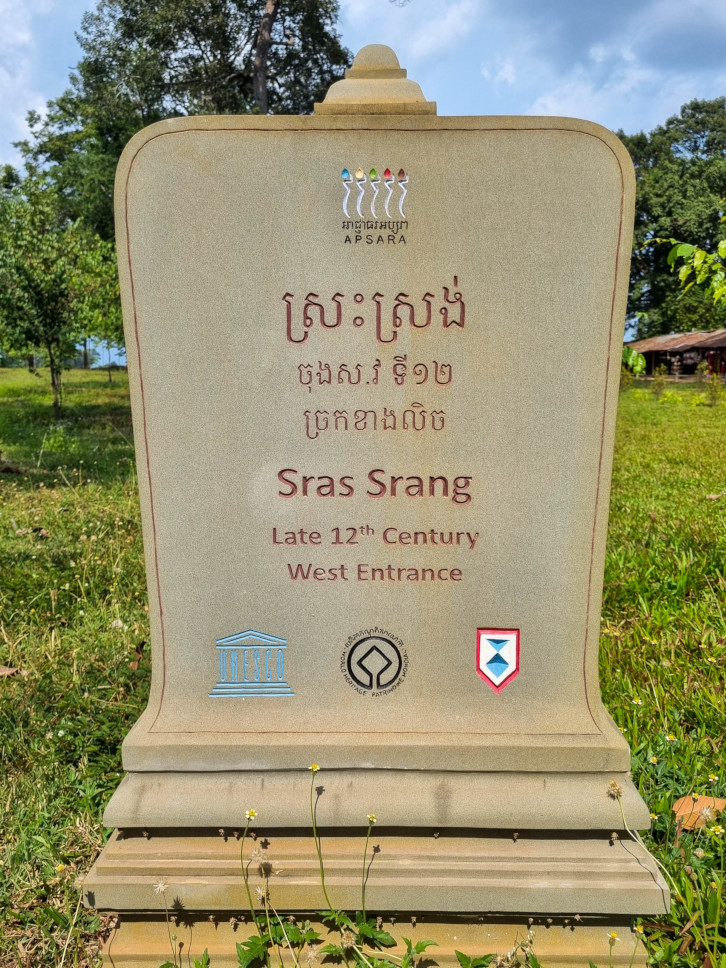
Sras Srang
End of 12th century Jayavarman VII. A large basin (the royal bath), 700 meters by 300, set on the axis of Banteay Kdei and bordered by stone steps. Originally excavated during the mid 10th century, to its west is an elegant terrace, and nearly at its center a small island on which there are some…
-

Preah Khan
1191 AD Jayavarman VII Buddhist. A royal city forming rectangle of 700 by 800 meters surrounded by a moat and similar to Ta Prohm, but with only four enclosures. Opens to the east to a baray (at the center of which is Neak Pean) via a terrace used originally as a boat landing. The large…
-

Phnom Krom
End of 9th century Yasovarman I. Hindu Perhaps the second of three temples built by Yasovarman I on the hills dominating the Angkor plain – the others being on Phnom Bakhengand, Phnom Bok. Badly deteriorated. Three sandstone sanctuaries aligned north-south are dedicated to the Brahmanic trinity – Shiva between Vishnu (north) and Brahma (south).
-

Prasat Bei
10th century Hindu (Shiva). Three small brick towers aligned north south on a common laterite base.