Category: united nations
-

Bat Chum
953 AD Rajendravarman II Buddhist. The first known Buddhist temple. Three brick sanctuaries with the main architectural elements in sandstone on a common moulded laterite base. Inscriptions give details of dedications to three Buddhist divinities and reveal the architect of the Eastern Mebon as its patron and builder. More at “The Angkor Survey“.
-

Baphuon
Middle of 11th century Udayadityavarman II Hindu (Shiva). A three tiered temple mountain – the “impressive copper tower even higher than the tower of gold” (the Bayon) described by Tcheou Ta-Kouan, a Chinese diplomat visiting at the end of the 13th century. Probably the central temple of the fourth kingdom of Angkor. More at “The…
-

Banteay Srei
967 AD Rajendravarman II Jayavarman V Hindu (Shiva) 25 kilometres to the north east of Angkor Thom. A jewel to which the nature of the material used – a finely textured rose coloured sandstone – is perfectly suited. Monumental size and architectural theme give way to a miniature scale and a dense and exquisite detail…
-

Banteay Kdei
End of 12th century Jayavarman VII Buddhist temple of four enclosures, the outer measuring 700 by 500 metres, showing signs of at least two stages of construction in differing styles. Typical of Jayavarman VII, but in an advanced state of ruin. More at “The Angkor Survey“.
-

Baksei Chamkrong
947 AD Hashavarman I Rajendravarman II Hindu (Shiva). A temple mountain set back in the trees at the base of Phnom Bakheng, in materials typical of the 10th century. A brick tower opening to the east and originally decorated with stucco moulding surmounts four diminishing tiers in laterite – the upper-most of which is moulded…
-

Angkor Wat
Beginning of 12th century Suryavarman II Hindu (Vishnu). A pyramid temple in three tiers built on an artificial mound with four enclosures and opening unusually to the west, suggesting this was the funerary temple of Suryavarman II. The external wall forms a rectangle of 1025 by 800 metres which is enclosed by a moat 190…
-

Bakong
881 AD Indravarman I Hindu (Shiva). A temple mountain enclosed within a laterite wall and two moats – the third suchtemple after Ak Yum and Rong Cheng (at Phnom Kulen to the north east) and the first to make extensive use of sandstone. The central sanctuary in the Angkor Wat style, which was probably built…
-
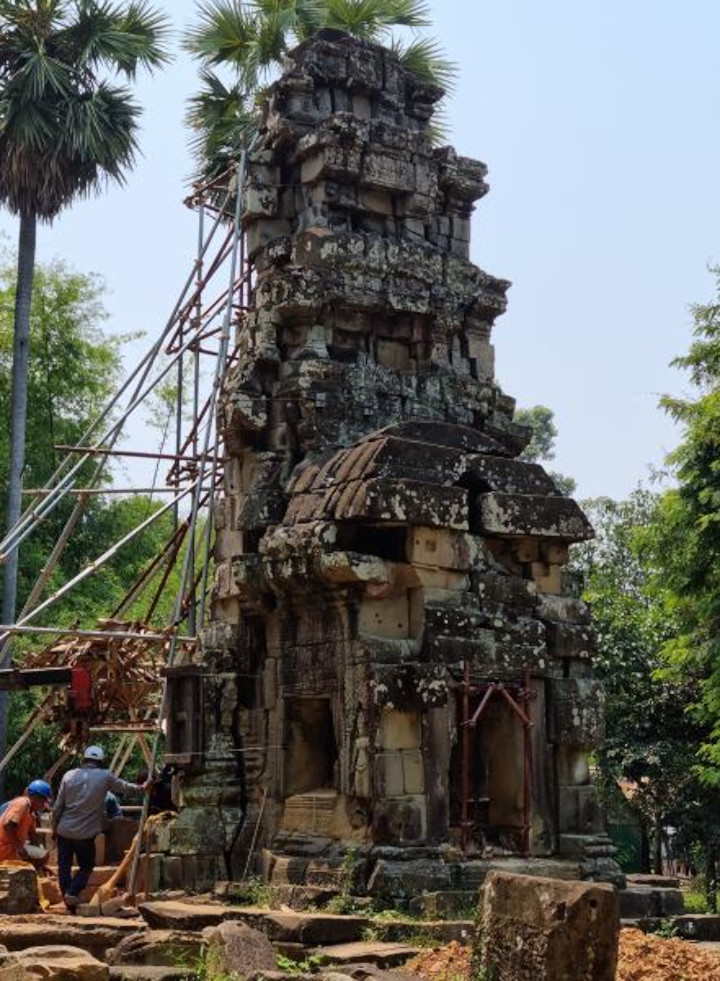
Ta Prohm Kel
End of 12th century Jayavarman VII Buddhist. A lone sandstone tower within a single ruined laterite enclosure. The stele discovered at Ta Prohm in 1928 gives details of 102 hospitals established by Jayavarman VII. This building is probably the chapel of one of these. One stands outside each of the cardinal gates to Angkor Thom.…
-

Ak Yum
Beginning of 7th century, Hindu. A small three tiered brick pyramid with primary elements in sandstone, still mostly buried under the 11th century dike of the western baray. Thought to be central to the first ancient capital city, inscriptions give the dates 609 AD, 704 AD and 1001 AD. Not much remains. More at ‘The…
-

The Angkor Survey
There are over a hundred major temple sites to be visited in and around Siem Reap – the religious remains of a series of cities during the Khmer Empire era, built by a succession of kings from around the 7th to the 13th centuries. The following is a survey of the Angkor archeological region during…
-

Banteay Samre
Beginning of 12th century Suryavarman II Hindu (Vishnu). A finely proportioned temple from the classic period, undated but perhaps a little later than Angkor Wat. Dismantled and reconstructed between 1936 and 1944. More at ‘The Angkor Survey‘. View Larger Map